Your business has a working website, an established user base, and a product that delivers value. At some point, the question comes up: should we build a mobile app?
It is a reasonable question. Mobile usage continues to grow, customer expectations are shifting, and your competitors may already have an app in the store. But moving from web to mobile is not just a technical decision — it is a strategic one.
Before diving into how to build a mobile app, it is worth asking whether you should, and if so, what kind.
Do You Actually Need a Mobile App?
Not every business does. A responsive web experience covers a significant portion of mobile use cases, and building an app requires investment, ongoing maintenance, and a clear value proposition for the end user.
The cases where mobile makes sense tend to share common traits: the product benefits from native device features (camera, GPS, push notifications, biometrics), users interact with it frequently and expect fast, offline-capable access, or the app itself becomes a channel for retention and engagement that a browser simply cannot match.
If any of these apply to your product, the conversation shifts from "should we?" to "how do we do this right?"
Hybrid or Native: What Is the Difference and Why Does It Matter?
This is where most businesses hit their first real decision point. There are two main approaches to mobile development, each with genuine trade-offs.
Hybrid Development (React Native, Flutter)
Hybrid frameworks let you build a single codebase that runs on both iOS and Android. The appeal is clear: faster development cycles, a shared team, and lower initial cost.
For most B2B and consumer products, hybrid is more than capable. React Native, for example, powers apps used by millions of people daily. Performance has improved significantly, and the gap between hybrid and native has narrowed considerably in recent years.
The limitations appear at the edges: deeply complex animations, hardware-specific integrations, or very high-performance requirements can push a hybrid app to its limits. These are real constraints, but they affect a minority of use cases.
Native Development (Swift for iOS, Kotlin for Android)
Building natively means writing separate codebases for each platform, using the tools and languages each operating system was designed for. The result is the best possible performance, the most seamless access to platform features, and a user experience that feels exactly as intended.
The trade-off is cost and complexity. Two codebases mean two development efforts, two release cycles, and a larger team to maintain everything long-term. For products where performance and platform depth are critical — think fintech, health, or hardware-connected applications — this investment is justified.
How to Decide
There is no universal answer, but there are clear signals.
Choose hybrid if your product needs to reach both platforms quickly, your feature set is standard, and speed to market matters. It is also the right call if your web team already works in JavaScript and you want to keep the stack familiar.
Choose native if you are building something that depends heavily on platform-specific capabilities, your users will notice — and care about — performance differences, or you are in an industry where quality and trust are non-negotiable.
And if you are genuinely unsure, a well-scoped proof of concept on one platform can answer the question before you commit to either path fully.
Making the Transition From Web to Mobile
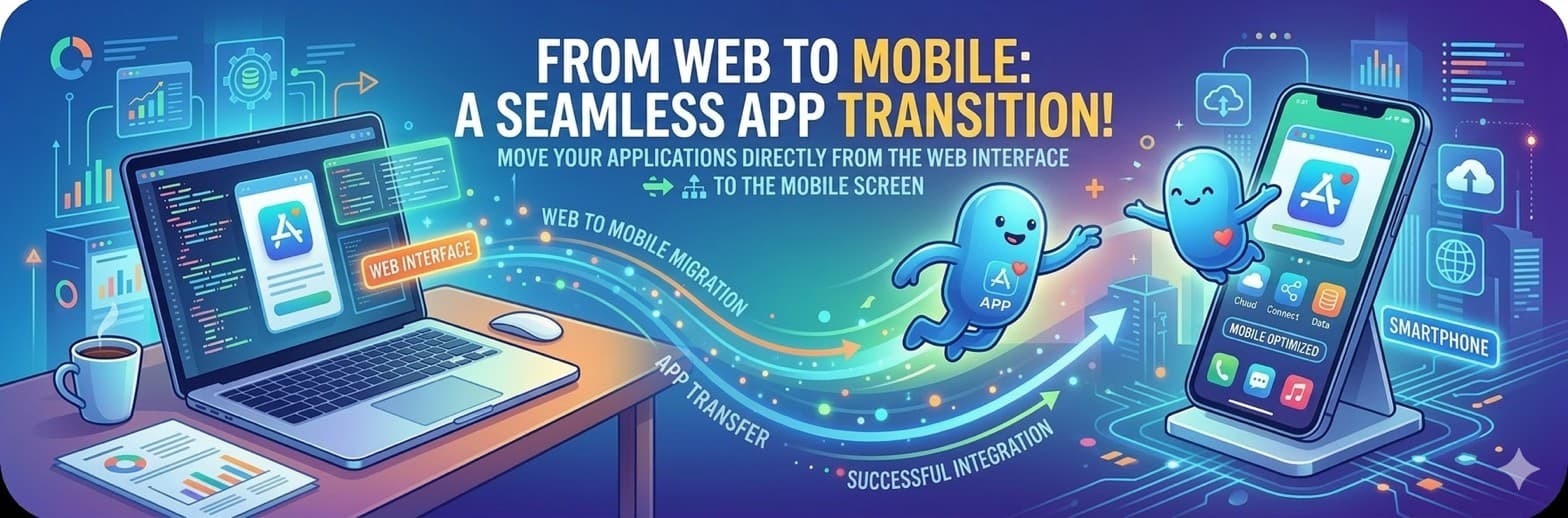
The good news for businesses with an existing web product is that you are not starting from zero. Your business logic, your API layer, and your understanding of your users are all transferable assets. A mobile app, in most cases, becomes a new interface to a foundation you have already built.
What changes is the context of use. Mobile users have different expectations: speed, simplicity, and interactions designed for a hand rather than a keyboard. Adapting your product for that context — rather than simply shrinking your website into an app — is what separates a useful mobile experience from one that feels like an afterthought.
A Partner for the Transition
At Ethical Algorithm, we work with businesses that have proven web products and are ready to extend their reach into mobile. Whether that means a hybrid app to validate the market quickly, or a fully native experience built for scale, we help you make the right technical decision for your business context — and then execute it.
If you are thinking about making the move to mobile, let us talk.