The Cost of Committing Too Early
Every business idea starts with a question: will this actually work?
For years, the only way to find out was to commit fully. Build the product. Hire the team. Invest the budget. And then, months later, sometimes after spending hundreds of thousands of euros, discover that the market didn't respond the way you expected, or that the technical assumptions were wrong from the start.
That approach carries enormous risk. And for most businesses, it is simply unsustainable.
There is a better way to find out if your idea is worth pursuing: a Proof of Concept.
What Is a Proof of Concept (POC)?
A Proof of Concept is a focused, time-limited exercise designed to validate the core assumptions behind a business idea, before you commit to full development.
It is not a finished product. It is not a polished prototype. It is the minimum necessary to answer one critical question: does this idea work in practice?
A POC can take many forms depending on your context:
- A web application that simulates the core user flow
- A mobile interface that tests a key interaction or journey
- An automated process that replaces a manual task and measures the result
- A simple integration that connects two systems and validates the data exchange
What matters is not what it looks like. What matters is what it tells you.
The Process: How We Guide You From Idea to Validated Concept
At Ethical Algorithm, we don't hand you a document and send you off to figure it out. We guide the entire process, side by side, from the first conversation to the final evaluation.
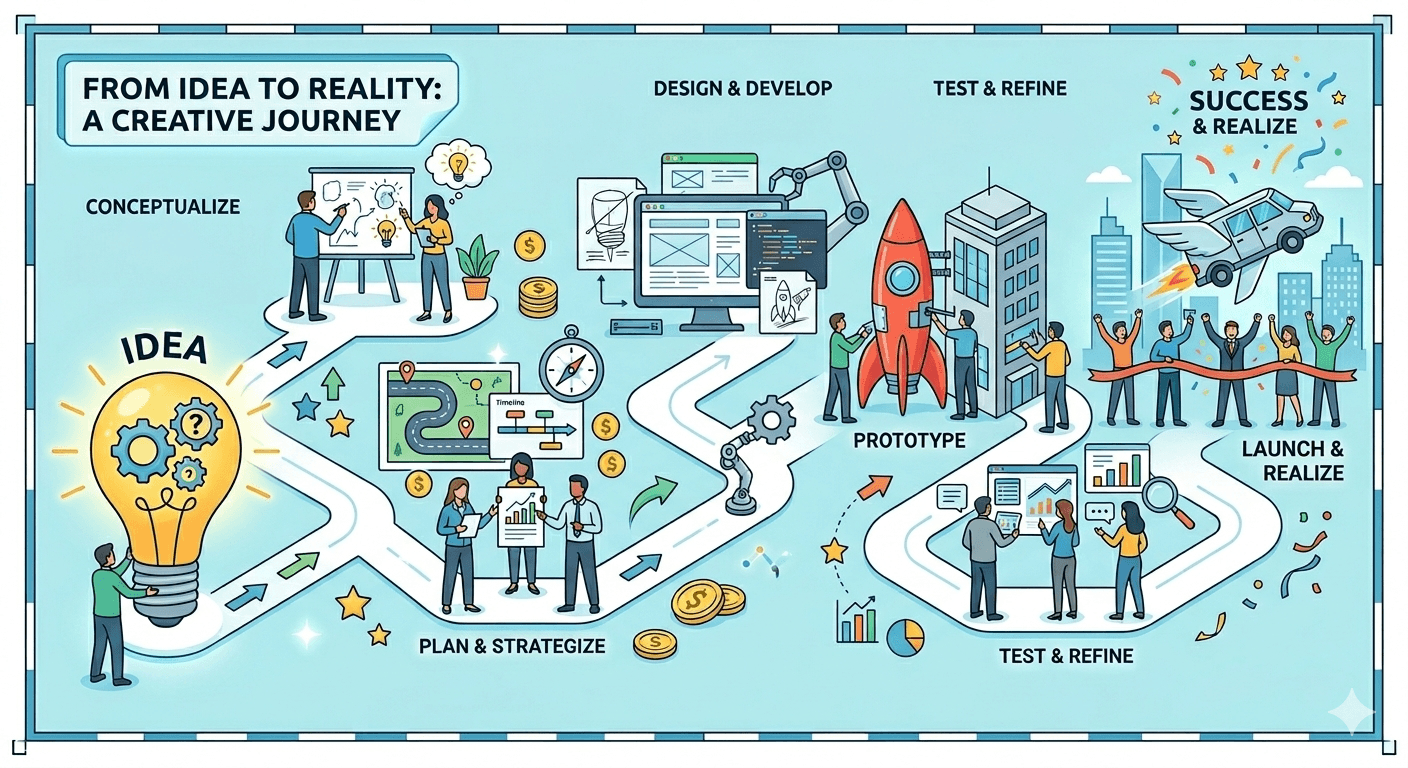
1. Conceptualise We start by understanding the idea in full, the business problem, the assumptions, the success criteria. We challenge the concept constructively, identifying the most critical hypotheses that need to be tested.
2. Plan & Strategise Together, we define the scope, timeline, and budget for the POC. We agree on what success looks like before writing a single line of code. This keeps the process focused and the expectations aligned.
3. Design & Develop With AI integrated into our development workflow, we move fast. What used to take weeks to scaffold and configure now takes days. We build only what is needed to test the hypothesis, no more, no less.
4. Prototype The working prototype is deployed in a real environment. You can interact with it, share it with internal stakeholders, and start collecting early feedback. This is where assumptions meet reality.
5. Test & Refine We analyse the results together. What worked, what didn't, and what needs to change. This stage is as valuable as the build itself, it is where you learn what your next step should be.
6. Launch & Realise If the POC validates the concept, you move forward with confidence. If it reveals a pivot is needed, you have made that discovery at a fraction of the cost of full development.
The Honest Case: Pros and Cons of Running a POC
Before deciding whether a POC is right for your situation, it is worth understanding both sides clearly.
The Advantages
Reduced financial risk. You invest a controlled, defined budget to test assumptions before committing to full development. If the idea doesn't hold up, you stop early and redirect resources.
Faster time to insight. With AI-assisted development, POCs that once took months can now be completed in weeks. You get real answers, fast.
Stakeholder alignment. A working prototype is far more persuasive than a presentation or a spreadsheet. It gets internal teams, investors, and decision-makers on the same page.
Informed decision-making. A POC gives you evidence. Not opinions, not assumptions, actual data from real usage. That changes the nature of the conversation around investment and next steps.
Flexibility to pivot. If the concept needs to change direction, a POC reveals that early, when pivoting is still affordable and low-risk.
The Limitations
A POC is not a finished product. It is built to test, not to scale. The decisions made for speed during a POC may need to be revisited in full development.
It requires clear success criteria. A POC without defined objectives tends to drift. Without knowing what you are trying to prove, it is difficult to interpret the results objectively.
It demands engagement from your side. The process works best when there is active collaboration. We need your domain knowledge, your feedback, and your decisions at each stage.
Not every idea is suited to a POC. For highly regulated industries or deeply complex integrations, the path to validation may require a different approach. We will always advise honestly if that is the case.
Why This Matters Now
The introduction of AI into the software development process has fundamentally changed the economics of testing ideas.
Projects that previously required large teams, extended timelines, and significant upfront investment can now be scoped, built, and deployed in a matter of weeks, at a cost that is accessible to startups, scaleups, and established businesses alike.
This does not mean development has become trivial. It means the barrier to validating an idea has come down significantly. And that changes the strategic options available to you.
Start with a Conversation
If you have a business idea, an internal process you want to automate, or a digital product you want to test, we can help you find out if it is worth pursuing, quickly and without unnecessary risk.
The process starts with a conversation. Let's talk.